Many organizations are still running data warehouses that were implemented five, ten, or even fifteen years ago. On the surface, these systems appear functional. Reports still run. Dashboards still refresh. The business has adapted its workflows around them, sometimes to such a degree that the limitations feel like normal operating conditions.
But as pressure mounts to support modern analytics, AI initiatives, and faster decision-making, the constraints of legacy warehouse infrastructure become harder to ignore — and harder to justify.
Organizations that have migrated to Databricks tend to report a consistent set of discoveries about cost, performance, and flexibility that they did not fully anticipate until they were on the other side.
The Hidden Cost of Staying on Legacy Warehouse Infrastructure
The most dangerous characteristic of legacy warehouse costs is that they accumulate gradually. There is rarely a single moment where the expense becomes obvious. Instead, the costs compound quietly until they start to visibly constrain what the business can do.
Licensing and infrastructure. Traditional warehouse licensing models were designed for predictable, fixed workloads. As data volumes grow and new use cases emerge, costs scale steeply and often unpredictably. Organizations frequently find themselves paying for capacity they cannot fully use while also running out of room for new workloads.
Custom integration overhead. Connecting legacy warehouses to modern data sources — cloud applications, streaming feeds, SaaS platforms — typically requires custom development. Each new integration adds to a growing library of pipelines that must be maintained, monitored, and updated when sources change.
Compute inefficiency. Legacy systems are often configured for peak workload capacity, meaning resources sit idle during off-peak hours while still incurring cost. There is no elasticity to match resource usage to actual demand.
Technical debt and innovation lag. When data teams spend the majority of their time maintaining aging infrastructure and managing its limitations, there is little bandwidth left for building new capabilities. The backlog of analytics requests grows while the team runs in place.
Talent friction. Data engineers who want to work with modern, cloud-native tooling are less attracted to organizations still running on legacy warehouse technology. Recruiting and retaining strong data talent becomes harder over time.
Taken together, these costs do not just affect the data team. They slow down every part of the business that depends on reliable, timely, and flexible analytics.
Key Architectural Differences Between Databricks and Traditional Data Warehouses
Understanding why Databricks changes the equation requires a clear picture of what makes the two architectures fundamentally different.
Traditional data warehouses are built around tightly coupled compute and storage. Data lives inside proprietary formats that the warehouse engine controls, and analytics capabilities are largely limited to SQL-based reporting. The architecture is optimized for a specific set of workloads and becomes difficult to extend when requirements evolve.
Databricks uses a lakehouse architecture that separates storage from compute and unifies them through an open, flexible layer.
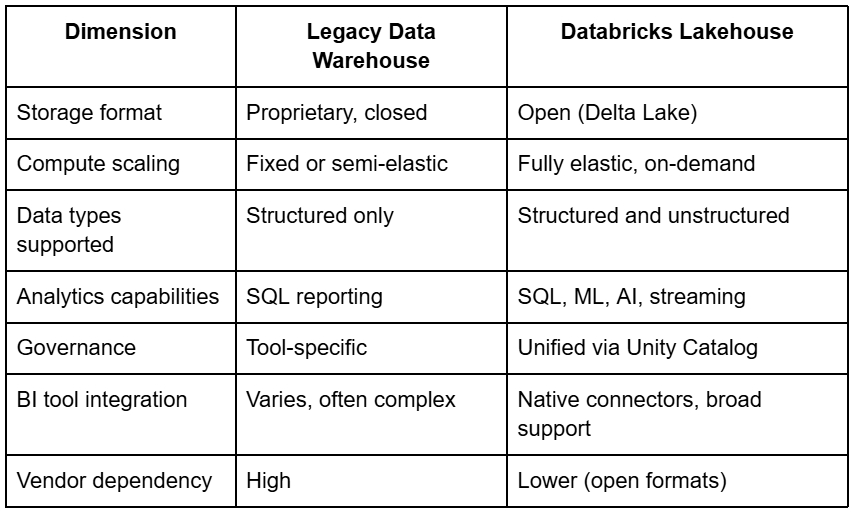
This architectural shift does not just change how data is stored. It changes what teams can build on top of it — and how quickly they can respond when requirements change.
What Migration Looks Like When Optimum Leads the Project
The most common migration mistake organizations make is treating the move to Databricks as a technical lift-and-shift rather than a strategic opportunity. Recreating the same structures, the same inefficiencies, and the same data models in a new platform misses most of the value the migration is supposed to deliver.
Optimum-led migrations are structured around business outcomes, not just technical completion.
Phase 1: Workload inventory and prioritization. Before anything moves, we assess the existing warehouse to understand what is actually being used, what is redundant, and what the business relies on most. High-impact datasets, reports, and pipelines are identified so migration effort is concentrated where value is highest.
Phase 2: Architecture design and environment setup. We design the target Databricks environment — including data zones, ingestion patterns, governance policies, and compute configurations — before migration begins. This prevents structural problems that are expensive to fix after the fact.
Phase 3: Phased data and workload migration. High-priority workloads migrate first, allowing the team to validate performance, catch issues early, and demonstrate early wins to business stakeholders. This phased approach also reduces risk compared to a full cutover.
Phase 4: Data model modernization. Where appropriate, we modernize legacy data models rather than simply recreating them. Outdated schemas are updated, duplicated logic is consolidated, and deprecated dependencies are retired rather than brought forward.
Phase 5: Enablement, validation, and go-live. Business users validate that reports and dashboards are working as expected. Data teams are trained on Databricks capabilities. The legacy environment is decommissioned on a defined schedule rather than left running indefinitely.
This structured approach minimizes disruption to ongoing operations and accelerates the timeline to realizing the full benefits of the new environment.
Performance, Cost, and Scalability: What to Expect After Go-Live
The post-migration experience varies based on what an organization migrated from and how well the new environment was designed. However, we see several common outcomes:
Faster query performance. Databricks’ compute layer and optimized storage formats deliver significantly faster query execution for many workloads, particularly complex analytical queries over large datasets. Reports that previously took minutes to load often complete in seconds.
More predictable and flexible costs. Rather than fixed infrastructure costs that do not flex with demand, Databricks compute scales to match actual usage. Organizations that design their environments thoughtfully — with appropriate cluster configurations and auto-termination policies — often see meaningful cost reductions compared to their legacy environment.
New use cases become feasible. Once data is no longer constrained by warehouse limitations, teams can pursue workloads that were previously impractical — streaming analytics, machine learning, large-scale data science — using the same platform that supports their core BI needs.
Data teams shift their focus. Perhaps the most significant change is not technical. When data teams are no longer spending their time managing infrastructure and firefighting pipeline failures, they can invest that capacity in building new capabilities and responding to business needs faster.
Stakeholder trust improves. When data is governed consistently and reports reflect the same underlying logic, business users develop more confidence in the numbers. Decisions get made more quickly and with less debate about data accuracy.
Common Migration Pitfalls — and How to Avoid Them
Even well-intentioned migrations can run into trouble. The most common issues fall into a predictable set of patterns.
Migrating existing inefficiencies. Organizations sometimes move broken or redundant pipelines into Databricks without cleaning them up first. The result is a modern platform hosting legacy problems. The migration process is an opportunity to address technical debt — not preserve it.
Underinvesting in governance. The Databricks environment is only as trustworthy as the governance framework built around it. Organizations that skip or defer governance work — access controls, data quality rules, lineage tracking — find themselves dealing with the same data trust issues they had in their legacy environment.
Neglecting user enablement. A successful migration is not just a technical achievement. If business users do not understand what changed, cannot access what they need, or lose confidence in familiar reports, adoption suffers. Enablement and communication deserve as much planning attention as the technical implementation.
Underestimating dependencies. Legacy warehouses often have more downstream dependencies than anyone realizes — reports, extracts, scheduled jobs, and integrations that were built over years. A thorough inventory before migration prevents surprises after cutover.
Setting unrealistic timelines. Complex migrations take time when done properly. Rushing the process to hit an aggressive target often introduces the exact disruptions it was meant to avoid.
Avoiding these pitfalls requires honest scoping, clear success criteria, and a migration partner who has seen what goes wrong and knows how to prevent it.
About Optimum
Optimum is a proud Databricks Partner and an award-winning IT consulting firm providing AI powered data and software solutions with a tailored approach to modernizing systems, processes, and analytics for mid-market and large enterprises. Our team combines deep expertise across data management, business intelligence, AI and ML, and custom software solutions to help organizations enhance efficiency, improve visibility, strengthen decision making, and reduce operational and labor costs.
From application development and system integration to data analytics, artificial intelligence, and cloud consulting, we are your one-stop shop for your software consulting needs.
Contact us: info@optimumcs.com | 713.505.0300 | www.optimumcs.com
Frequently Asked Questions
Is Databricks more expensive than a traditional data warehouse? Total cost depends heavily on usage patterns, current licensing arrangements, and how the Databricks environment is configured. Many organizations find Databricks more cost-effective over time due to elastic compute scaling, reduced infrastructure overhead, and the elimination of specialized integrations. A thorough cost analysis during discovery provides a realistic comparison.
Do we need to migrate everything at once? No, and a big-bang migration approach carries significant risk. A phased migration reduces disruption, allows early value realization, and gives teams time to learn the new platform before it carries the full production workload.
Will business users need retraining? BI users who access reports and dashboards through existing tools typically experience minimal disruption — they continue working in the same interfaces with the same or improved data. Data engineers and analysts will benefit from enablement to fully leverage Databricks capabilities beyond what they had before.
Can Databricks handle regulated or sensitive data? Yes. Databricks supports robust governance, access controls, encryption, and audit logging. When configured correctly — particularly with Unity Catalog for centralized governance — it is well-suited to regulated environments including healthcare, financial services, and other compliance-intensive industries.
How do we know if our organization is ready for this migration? Readiness depends on clarity of business goals, available internal expertise, and appetite for managing change. An Optimum discovery engagement can assess your current environment and provide an honest view of what migration would involve, what it would cost, and what it would deliver.